iPhone Duo Hinge and Crease, Explained: How Apple Keeps a Folding Screen Flat and Durable
· By Xin Wang · 中文
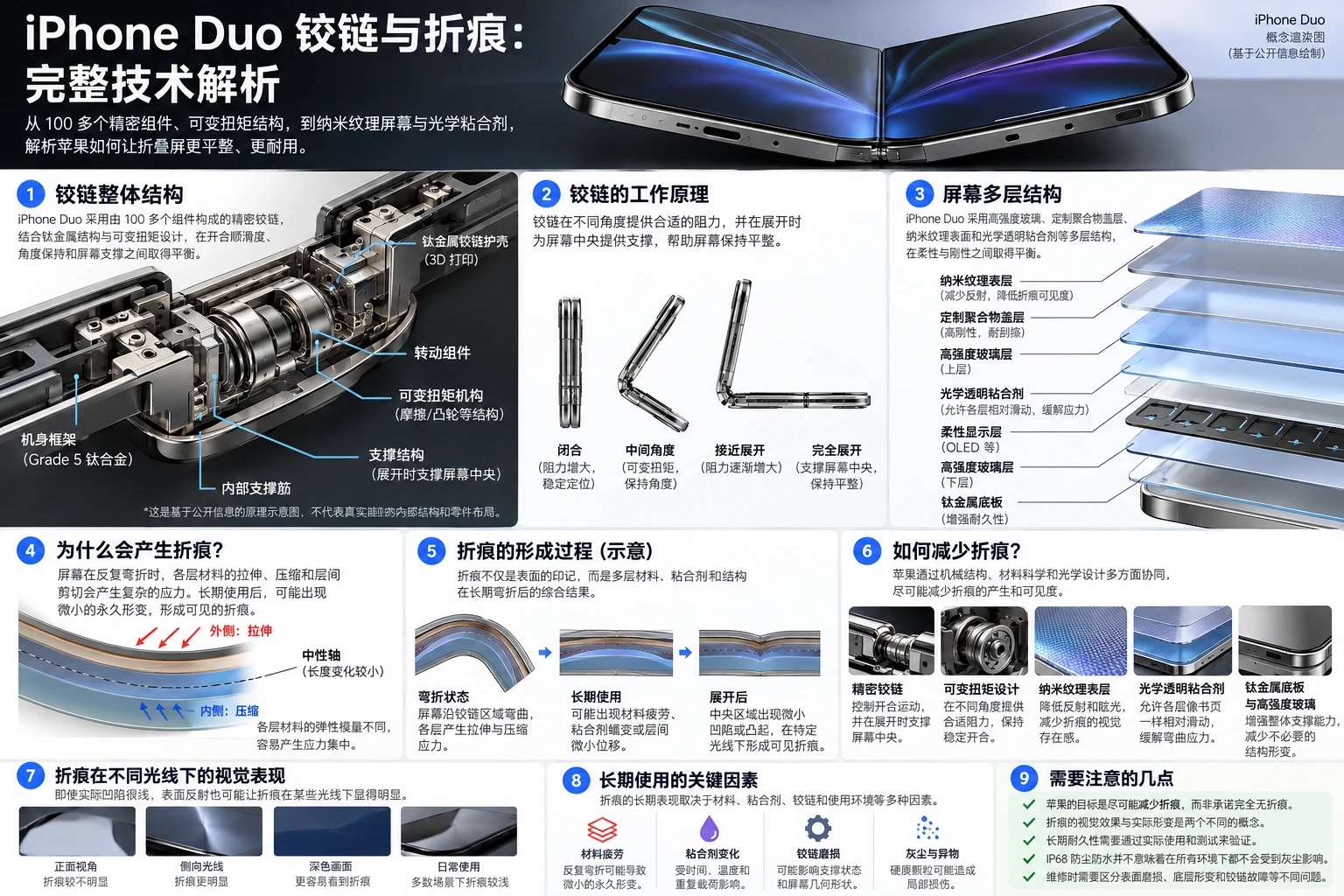
From a hinge built from more than 100 components and its balanced resistance, to a nano-texture surface and adhesive layers that glide past each other, this article looks at how Apple's folding iPhone Duo deals with the crease, from four angles: mechanics, materials, optics and long-term use. Everything described as confirmed by Apple links to Apple's own pages; anything explained from engineering principles is labelled as such, not as the actual internal design of iPhone Duo.
Summary
- Confirmed by Apple: the hinge has more than 100 components and supports the centre of the display when open; the hinge cover is 3D-printed grade 5 titanium.
- The crease is handled by several layers working together: a nano-texture finish cuts reflections, a polymer cover layer is up to 40% stiffer, custom adhesives let the layers glide like book pages, and a titanium plate sits underneath.
- Not zero crease: Apple's own wording is "as much as possible", and hands-on reports say it is still visible in some light.
- Not published: the hinge's internal layout, fold-cycle rating, crease depth and any long-term data.
- The hard part is getting flat again
- The hinge: what 100+ components mean
- Why folding screens crease
- How Apple reduces the crease
- Is it really crease-free?
- Will the crease deepen over time?
- Dust and long-term reliability
- The hinge and cooling
- Repairs: which damage is separate
- Summary
- FAQ
- Sources
1. The hard part is not folding, it is getting flat again
A bar-shaped phone's display is fixed to a fairly rigid body and is almost never bent. A folding phone is different: closed, the inner display bends through the hinge area; open, it has to return as flat as possible. That creates three linked problems:
- No excessive local stress when bent. If any layer bends to too small a radius, the material is stretched or compressed too far, and repeated folding can lead to permanent deformation, fatigue or even delamination.
- Enough support when open. A flexible display cannot hold itself flat like rigid glass; the hinge and the support underneath have to work together to keep the centre from sinking.
- Good optical behaviour at the surface. Even a very shallow dip changes how light reflects, so the crease can look obvious in some light.
So the goal is not just a hinge that turns, but precise control of the whole movement from open to closed, and of the forces and deformation in the display along the way.
2. The iPhone Duo hinge: what do more than 100 components mean?
According to Apple's announcement, the iPhone Duo hinge is engineered from more than 100 components to precisely control opening and closing and to support the centre of the display when open. The hinge cover is 3D-printed, and both the frame and the hinge cover are grade 5 titanium.
More than 100 components does not mean they are all gears or shafts in the traditional sense; a precision hinge can include rotating parts, supports, stops and friction elements. What Apple has published shows the hinge is complex, but it is not enough to reconstruct where each part sits in the production phone.
Balanced resistance: the right feel at every angle
Torque describes the turning effect of a force. Hinge resistance should be neither as high nor as low as possible: too little and the screen will not hold a mid angle; too much and every opening takes effort and puts more load on the hinge. Apple's own description is that the hinge opens and closes with "smooth, balanced resistance".
This kind of feel is usually achieved with combinations of friction elements, springs, cams and similar parts. That is a general engineering explanation; Apple has not confirmed which layout iPhone Duo actually uses, and designs shown in Apple patents should not be taken as the production hinge.
Also, how the hinge feels and how deep the crease is are different things. Resistance governs movement and holding position; the crease depends on the bend path, the materials, the bonding between layers and the support once open.
Centre support: what keeps the screen flat once it is open?
The middle of the screen is both where it bends over and over and where deformation most needs controlling. If the hinge only joined the two halves, the screen could still sag when open. Apple says the hinge supports the centre of the display when open, and that internal ribs and a titanium plate under the display add rigidity. Each part has its own job:
- the hinge controls how the two halves move relative to each other;
- the centre support helps the display hold its shape when open;
- internal reinforcement reduces bending and twisting of the body itself;
- the titanium plate strengthens the support under the display.
3. Why do folding screens crease?
A crease is not just a mark on the surface protector. Apple's product page says the iPhone Duo inner display is made of more than 10 ultra-thin layers. Each differs in thickness, elasticity and bonding, so each takes a different load when bent: the outside is mainly stretched, the inside mainly compressed, and somewhere between is a region whose length changes little (around the neutral axis). Where that axis sits depends on the layers' thickness and stiffness, not necessarily on the geometric centre.
After many folds, a screen may show:
- tiny permanent deformation in some materials;
- creep or fatigue in the adhesive layers;
- layers shifting relative to each other, or a risk of delamination;
- an inability to return fully to its original shape when opened.
These can leave a tiny dip or ridge in the middle. Even a very small height difference changes reflections noticeably, and the eye sees a clear line. So a crease is really two problems: the physical deformation of the screen, and how visible that deformation is. That is why some folding screens show almost no crease head-on but an obvious one under side light.
4. How Apple reduces the crease: layers working together
Apple does not rely on any single material. The following all come from Apple's announcement.
1. Nano-texture surface: fewer reflections, a less visible crease
A glossy surface produces sharp mirror reflections; when a light source passes over a tiny dip in the middle, the reflection shifts and a clear light-dark line appears. The nano-texture changes how the surface reflects, reducing glare and mirror reflections; Apple's own words are that it "minimises crease visibility".
Two things need separating: making the crease less visible is not the same as removing it. If a tiny height difference remains underneath, the nano-texture does not make it perfectly flat; it changes how light interacts with the surface. So when judging a crease, look in indoor light, bright light, side light and with dark content.
2. A stiffer polymer cover layer
The inner display's surface is a custom polymer cover layer with up to 40% higher stiffness than other materials commonly used in the industry, plus a scratch-resistant coating. Stiffness is a material's resistance to deformation; it does not translate directly into crease resistance for the whole screen, which also depends on thickness, bend radius, bonding and long-term fatigue. Simply making one layer stiffer can push stress into other layers, so the cover has to be designed together with the support, adhesives and hinge.
3. Custom adhesives that let the layers glide like book pages
This is a key part of how iPhone Duo controls the crease. Apple says high-strength glass sits above and below the folding display panel, with custom adhesives that "allow the layers to glide past one another like the pages of a book, relieving bend stress".
Think of the display as a book: glue every page together and closing it forces each page to follow the others, adding stretch and compression between them; let the pages slide a little and it bends far more easily. A display is not paper, but the principle holds. The difficulty is balance: bond too firmly and the layers cannot move; bond too weakly and you risk delamination, bubbles or lifting. So the point of a custom adhesive is not to make it softer, but to control how it behaves, mechanically and optically, over many bends.
4. Titanium plate and high-strength glass: support that still allows folding
High-strength glass sits on both sides of the folding panel, and a titanium plate at the bottom further improves durability. That does not mean the whole folding area is rigid, or the screen could not bend at all. The real challenge is keeping the necessary flexibility where it must bend and enough rigidity elsewhere; the glass, the titanium plate, the internal ribs and the hinge support each limit unwanted deformation.
5. Is iPhone Duo really crease-free?
Strictly speaking, Apple does not promise no crease under any conditions. Its own FAQ says the inner display is remarkably flat and smooth, the nano-texture reduces glare and reflections, and the optically clear adhesive lets the layers glide smoothly as the screen folds, "minimising stress and creasing as much as possible". MacRumors also reports that the crease can still be seen in some light, just not prominently.
Judging a folding screen's crease means at least three separate questions:
- Can you see it? That depends on the surface texture, reflections, light direction and what is on screen.
- Can you feel it? Even if it is hard to see, a finger sliding across the middle may still feel a change in height.
- Is it physically flat? That needs measuring the surface profile, not just photos or the naked eye.
One phone looking almost crease-free indoors does not mean it is crease-free in every light, let alone that its surface has no deformation at all.
6. Will the crease deepen over time?
This is the question most worth following. Apple has described the materials, hinge and support structures, but has not published data that would let anyone independently check how the crease changes over time. Four factors may matter:
- Material fatigue: repeated folding cycles stress through the flexible materials; if they do not fully recover each time, the shape of the middle slowly changes.
- Adhesive ageing: adhesives are viscoelastic and react to time, temperature and repeated loads; whether the layers and bonds stay stable has to be shown by testing.
- Changes in the hinge and support: friction surfaces, joints and stops change with use, which could alter resistance, play or support and so the open shape. But a well-used hinge does not by itself mean a deeper crease.
- Surface wear: wear on the protective layer and coating changes reflections and feel, so the crease can look more obvious even if the panel underneath has not deformed further.
A rigorous long-term test would photograph the middle under the same lighting, angle and distance; record it new and after long use; measure the surface height in the centre; log hinge resistance at different angles; and check for delamination, bubbles, touch or display faults. Apple has not published enough production data, so nobody should claim it survives hundreds of thousands of folds or that the crease will never deepen.
7. Dust and long-term reliability
Apple rates iPhone Duo IP68 for splash, water and dust resistance. That does not mean dust can never matter, and it does not rule out mechanical damage from hard particles: grit caught in the fold and squeezed when the phone closes puts a lot of pressure on a tiny area, which can damage the protective layer or even the structure beneath.
- Keep sand and hard debris out of the fold.
- Do not press on the crease with a pen tip, fingernail or other hard object.
- If the crease suddenly deepens, bulges, or the screen flickers or stops responding to touch, stop opening and closing it and have it inspected.
8. The hinge also has to work with the cooling
Apple confirms an advanced thermal management system for iPhone Duo, including a custom vapour chamber and a dual-battery architecture. But Apple's overall description does not by itself show which thermal parts pass through the hinge, nor the thermal path inside it. Whatever the layout, a folding phone has to fit the moving mechanism, display, batteries and cooling into limited space without any of them failing from repeated folding, which is one reason folding phones are so much more complex than bar phones.
9. Repairs: which kinds of damage are separate?
Surface wear, deformation underneath and hinge faults are different problems. A worn protective layer does not necessarily mean the flexible panel is damaged; equally, a perfect-looking surface does not rule out changes inside. Repairs should start by finding the source:
- mainly coating or cover-layer damage: check whether it can be handled on its own;
- display faults, local delamination or obvious deformation underneath: inspect the display assembly;
- abnormal resistance, looseness or catching when opening: inspect the hinge.
A crease alone does not prove the whole screen is damaged, and a faint crease does not prove nothing is wrong inside. What can be repaired, which parts can be replaced and what it costs depend on Apple's local service policy.
10. Summary: the real advance is controlling the crease as a system
iPhone Duo does not control its crease with one magic material, but with mechanics, layered materials and optical design together:
- Precision hinge: controls the movement and supports the centre of the screen when open;
- Smooth, balanced resistance: balancing easy movement, holding position and long-term reliability;
- Stiffer polymer cover and nano-texture: a more durable surface and a less visible crease;
- Custom adhesives: letting the layers glide in a controlled way to relieve stress;
- Titanium plate, glass layers and internal reinforcement: more overall support and less unwanted deformation.
Design goals and long-term results are still two different things. What can be confirmed is that Apple engineered the crease at several levels, and that its own wording is "as much as possible", not zero crease. Whether it works will show over the coming months and years: whether the centre stays flat, whether the hinge resistance stays consistent, and whether the surface keeps its optical and touch quality.
FAQ
Does the iPhone Duo folding screen really have no crease?
Apple does not promise zero crease. Its own wording is that the nano-texture finish reduces glare and reflections and the optically clear adhesive lets the display layers glide as it folds, "minimising stress and creasing as much as possible". Hands-on reports also note the crease can still be seen in some light, just faintly.
How many parts are in the iPhone Duo hinge?
Apple says the hinge is engineered from more than 100 components to control opening and closing and to support the centre of the display when open; the hinge cover is 3D-printed grade 5 titanium. Apple has not published the internal layout.
How many folds is the iPhone Duo hinge rated for?
As of October 2026 Apple has not published a verifiable fold-cycle rating, nor any data on how crease depth changes with use, so no specific number should be quoted.
Why does a folding screen crease?
A folding display is a stack of layers; when it bends, the outside is stretched and the inside compressed. After many folds, materials and adhesive layers can keep a tiny permanent deformation, leaving a small height difference in the middle when opened. That changes how light reflects, and the eye sees a line.
Sources
- Apple Newsroom: Apple unveils iPhone Duo
- Apple (Malaysia): iPhone Duo product page and FAQ
- MacRumors: Here's What Apple Says About the iPhone Duo's Crease
Read next
- iPhone Duo pre-order night at TRX: launch-day pickup gone in 10 minutes, then released 54 more times through the night.
- iPhone Duo pre-order guide: prices compared across regions, eSIM only, and in-store pickup.
- Specs library: specs and benchmarks for iPhone and Apple chips.
This is an independent third-party site with no affiliation with Apple Inc. The article is based on Apple's published information and general principles of mechanical engineering, materials and optics; the diagrams explain principles only and do not show the actual internal structure of iPhone Duo. Anything about internal part layout, long-term crease behaviour or durability is limited to what public evidence supports, and designs in Apple patents should not be taken as the production design.